


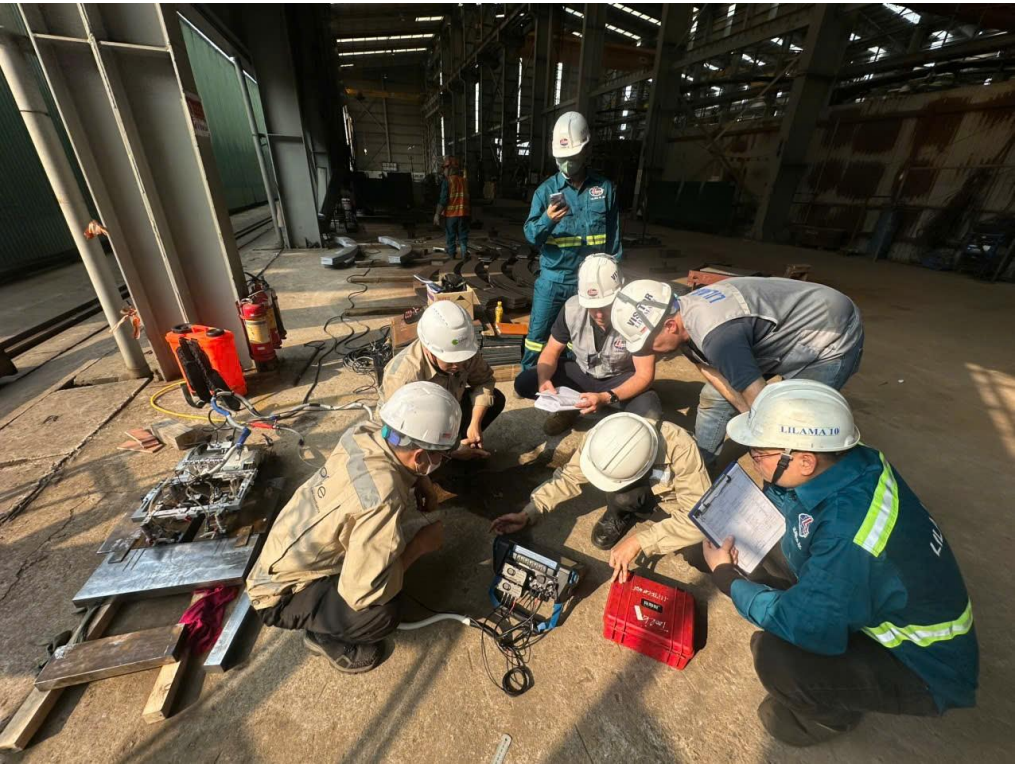
At High Technology Nondestructive Testing Service Co., Ltd, we provide Time-of-Flight Diffraction (ToFD)—one of the most reliable and efficient advanced NDT methods available today. Unlike traditional pulse-echo ultrasonic techniques that rely on reflected energy, ToFD utilizes the diffraction of sound waves from the tips of flaws, providing pinpoint accuracy in defect detection and sizing.
Precision Engineering for Critical Assets
ToFD is the industry standard for the initial inspection of new-build welds and the long-term monitoring of heavy-wall pressure vessels and piping.
-
Exceptional Sizing Accuracy: ToFD is widely recognized as the most accurate NDT method for measuring the height and length of internal cracks, enabling precise “Fitness-for-Service” (FFS) assessments.
-
Full Volume Coverage: A single scan provides a complete longitudinal cross-section of the weld, covering the root, fusion zone, and cap in one pass.
-
Detection of All Flaw Orientations: Because it relies on diffraction rather than reflection, ToFD is significantly less sensitive to the orientation of a defect, ensuring that “skewed” or vertical cracks are not missed.
The HTNDT Advantage: Speed & Reliability
-
Rapid Inspection Rates: Our automated ToFD crawlers can scan meters of welding in minutes, providing real-time imaging and significantly reducing project timelines compared to Radiography (RT).
-
Code-Compliant Alternative to RT: Fully recognized by ASME Section V (Article 4), ISO 10863, and ASTM E2373 as a safe, radiation-free alternative to X-ray testing.
-
Historical Traceability: Every scan creates a permanent digital “B-Scan” image. This allows for “base-lining”—comparing scans taken years apart to monitor if a known flaw is growing over time.
Specialized Expertise
ToFD data is complex and requires a high level of analytical skill. At HTNDT, our technicians are Level II and Level III certified experts specifically trained in ToFD data interpretation, ensuring that “noise” is never mistaken for a defect and that every signal is correctly characterized.
